
Executive Summary: What Is Microsoft’s October 2026 Voluntary Exit Offer (VEO)?
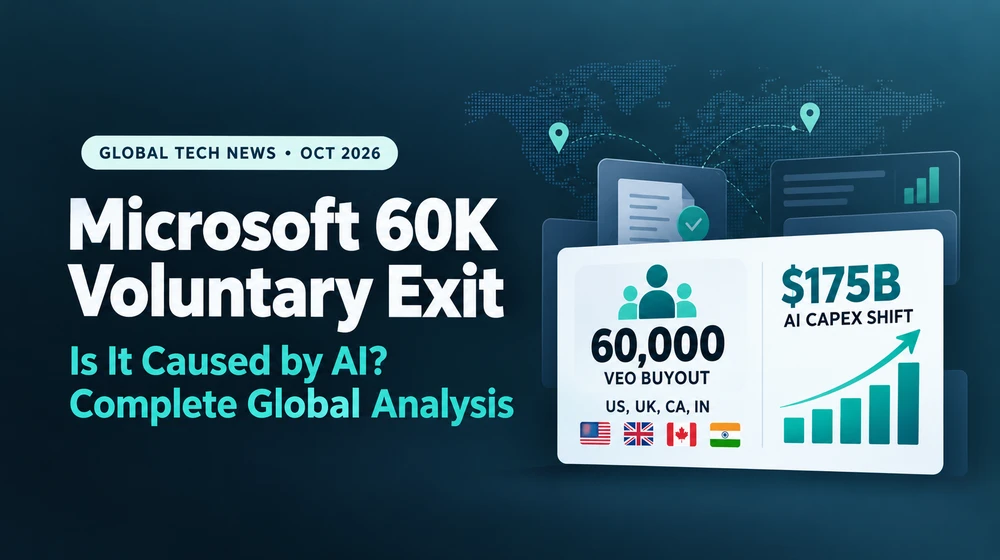
In one of the largest global workforce restructurings in Big Tech history, Microsoft officially introduced a Voluntary Exit Offer (VEO) on October 26, 2026, extending voluntary buyout packages to approximately 60,000 eligible employees across the United States, the United Kingdom, Canada, and India. Announced in an internal memo by Microsoft Executive Vice President and Chief People Officer Amy Coleman just ahead of the company’s quarterly earnings report, the program covers more than 27% of Microsoft’s 223,000 full-time global workforce (down from 228,000 at the end of 2025).
Unlike compulsory mass layoffs, the October 2026 Microsoft Voluntary Exit Offer gives eligible staff a time-limited window to voluntarily leave the company with a financial severance package, continued stock award vesting, subsidized temporary healthcare coverage, and career transition support. However, the sheer scale of the program—arriving simultaneously with Microsoft’s record $175 billion capital expenditure (CapEx) forecast for Artificial Intelligence infrastructure in 2026—has sparked an urgent question across the global technology sector: Is this massive Microsoft exit directly caused by AI?
Is the Microsoft Voluntary Exit Offer Caused by AI? The $175 Billion Connection
Across the global tech industry, millions of software engineers, enterprise leaders, and market analysts are asking: Is Microsoft’s 60,000-employee exit offer caused by AI? While Microsoft officially frames the VEO as a flexible option to help employees navigate career transitions and align teams with evolving business priorities, the underlying financial driver is undeniably the global Artificial Intelligence infrastructure race.
Four major economic and technological shifts explain why AI is at the center of Microsoft’s October 2026 restructuring:
- Funding the $175 Billion AI CapEx Surge: Microsoft has projected an unprecedented $175 billion in capital expenditure for 2026 to build hyperscale AI data centers, custom silicon chips, and high-density cloud computing clusters supporting OpenAI, Anthropic, and enterprise Azure AI workloads. Protecting operating margins while spending $175 billion on hardware requires aggressively streamlining traditional payroll overhead.
- Internal AI Automation & Agentic Coding Productivity: The rapid deployment of GitHub Copilot, CoreAI automation, and agentic AI workflows inside Microsoft and across the wider software industry allows leaner engineering squads to ship and maintain code that previously required large departments. Routine maintenance, boilerplate coding, and middle-management coordination layers are being consolidated worldwide.
- The October 2026 Global Big Tech Restructuring Wave: Microsoft is not acting in isolation. During the exact same week in late October 2026, Meta announced cuts of 8,000 jobs (roughly 10% of its workforce) and IT services giant Cognizant moved to eliminate 15,000 roles as the entire global technology sector pivots from mass headcount expansion to AI-driven workforce planning.
- Microsoft’s Third Major Workforce Cut of 2026: The October VEO follows Microsoft’s May 2026 US Voluntary Retirement Program (which offered buyouts to 7% of its US workforce, or roughly 9,000 employees) and its July 2026 Xbox gaming division restructuring (which cut 4,800 jobs—about 2.1% of its global staff—alongside plans to divest up to five gaming studios).
Global Eligibility Breakdown: Which Countries, Job Levels & Teams Qualify?
According to Amy Coleman’s official memo and internal briefings, the October 2026 Microsoft buyout package is significantly broader than earlier retirement schemes and follows specific organizational criteria:
- 4 Core Geographies Included (US, UK, Canada & India): The Voluntary Exit Offer is open to eligible full-time employees across Microsoft’s four largest international employment hubs: the United States, Canada, the United Kingdom, and India (where Microsoft employs approximately 23,000 professionals across Hyderabad, Bengaluru, Noida, and Pune).
- Job Level 70 and Below (Up to GMs & VPs): Eligibility extends up to Level 70 on Microsoft’s internal career hierarchy. This encompasses individual contributors, entry-level and senior Software Development Engineers (SDEs), Principal Engineers, Product Managers, General Managers (GMs), and certain leaders holding Vice President titles (excluding Corporate Vice Presidents and executive officers).
- No Minimum Age, Tenure, or Performance Requirement: Unlike the May 2026 US retirement offer, the October 2026 VEO has zero minimum age or length-of-service requirements, and employee performance review ratings play no role in determining eligibility.
- Participating Microsoft Business Units: Divisions offering the voluntary buyout include Copilot, CoreAI, Windows + Devices, Xbox, Finance, and Human Resources (HR), while Cloud + AI and Microsoft AI are partially participating.
- Excluded Microsoft Business Units: Direct revenue-generating and critical infrastructure units—specifically Sales, Marketing, Commercial Business, Cybersecurity / Security, Data Center Operations, and Discovery & Quantum teams—are excluded from the buyout offer.
Important Dates, Decision Deadlines & Severance Package Terms
Microsoft has established an accelerated fourth-quarter timeline for the Voluntary Exit Offer so participating divisions can finalize their 2027 headcount and operating budgets before the end of the calendar year:
- Offer Notification Window: October 26–27, 2026, delivered via individualized offer links sent directly to eligible employees' Microsoft email accounts.
- Final Decision Deadline: Eligible staff across the US, UK, Canada, and India have until December 1, 2026, to formally accept or decline the voluntary exit package.
- Final Departure Date: Employees who opt into the VEO will conclude their employment and exit Microsoft on December 31, 2026.
- Severance & Benefits Package: Exiting employees receive lump-sum cash severance calculated by base salary, job level, and years of service, alongside continued stock vesting, temporary healthcare coverage, and career transition assistance. Employees who decline the offer remain in their current roles, though Microsoft noted that the VEO does not replace standard performance management or future organizational restructurings, and the company is evaluating whether to make voluntary exit windows an annual program.
Will AI Replace Software Engineers? How the Global Tech Industry Is Evolving
When a global technology leader offers exit packages to 60,000 employees—including staff within its own Copilot and CoreAI divisions—CTOs, product leaders, and software engineers worldwide naturally ask: Are software engineering jobs disappearing because of AI?
Industry hiring data shows that software development is not disappearing—in fact, Microsoft posted hundreds of new specialized engineering openings in late October 2026 even as it rolled out the VEO. However, how software is built and how engineering teams are structured is undergoing a permanent shift:
- Consolidation of Single-Function & Boilerplate Roles: Organizations are reducing isolated roles focused purely on repetitive CRUD coding, manual testing, or legacy maintenance where AI coding assistants already deliver massive speedups.
- Shift Toward High-Impact System Architecture: While AI tools generate code snippets rapidly, enterprise systems still require experienced human engineers to design secure multi-tenant architectures, complex APIs, database schemas, and scalable cloud deployments across modern stacks such as Laravel, React, Next.js, Node.js, Angular, and React Native.
- Leaner Internal Teams & Agile Engineering Partnerships: Rather than carrying massive permanent corporate overhead across dozens of middle-management layers, enterprises in the US, UK, Europe, and Asia are operating leaner core teams and partnering with specialized software development agencies to build, modernize, and maintain custom web and mobile platforms efficiently.
Frequently Asked Questions (FAQ) About Microsoft’s 2026 Voluntary Exit Offer & AI Impact
1. Is Microsoft laying off 60,000 employees in October 2026?
No, this is not a mandatory layoff of 60,000 workers. On October 26, 2026, Microsoft introduced a Voluntary Exit Offer (VEO) giving approximately 60,000 eligible employees across the US, UK, Canada, and India (about 27% of its 223,000 global staff) the option to voluntarily accept a financial buyout package by December 1, 2026, with a final exit date of December 31, 2026.
2. Is Microsoft’s Voluntary Exit Offer caused by AI spending?
Yes, artificial intelligence is the primary financial catalyst. Microsoft forecasts a record $175 billion in capital expenditure for 2026 to expand AI chips, data centers, and cloud capacity for OpenAI, Anthropic, and Azure customers. The voluntary buyout helps Microsoft control operating and payroll expenses across traditional divisions while funding massive AI infrastructure growth.
3. Which countries and job levels are eligible for the Microsoft buyout package?
The offer is open to eligible full-time Microsoft employees in the United States, the United Kingdom, Canada, and India at Level 70 and below—covering individual contributors, software engineers, product managers, general managers, and certain vice presidents—with no minimum age, tenure, or performance rating requirement.
4. Which Microsoft divisions are included and excluded from the October 2026 VEO?
Participating divisions include Copilot, CoreAI, Windows + Devices, Xbox, Finance, and Human Resources, with Cloud + AI and Microsoft AI partially included. Teams in Sales, Marketing, Commercial Business, Cybersecurity, Data Center Operations, and Discovery & Quantum are excluded.
5. Why are Microsoft, Meta, and Cognizant all restructuring jobs in October 2026?
Alongside Microsoft’s 60,000-employee VEO, Meta announced 8,000 job cuts (10% of its staff) and Cognizant moved to cut 15,000 roles in late October 2026. Global tech companies are shifting capital away from high-headcount legacy operations toward leaner, AI-augmented engineering teams and cloud infrastructure.
6. Will AI replace software engineers in 2026 and beyond?
AI is not replacing software engineering as a profession, but it is replacing repetitive, single-function coding tasks. Global demand remains strong for full-stack engineers and agile development teams capable of architecting secure, scalable, end-to-end web and mobile applications.