
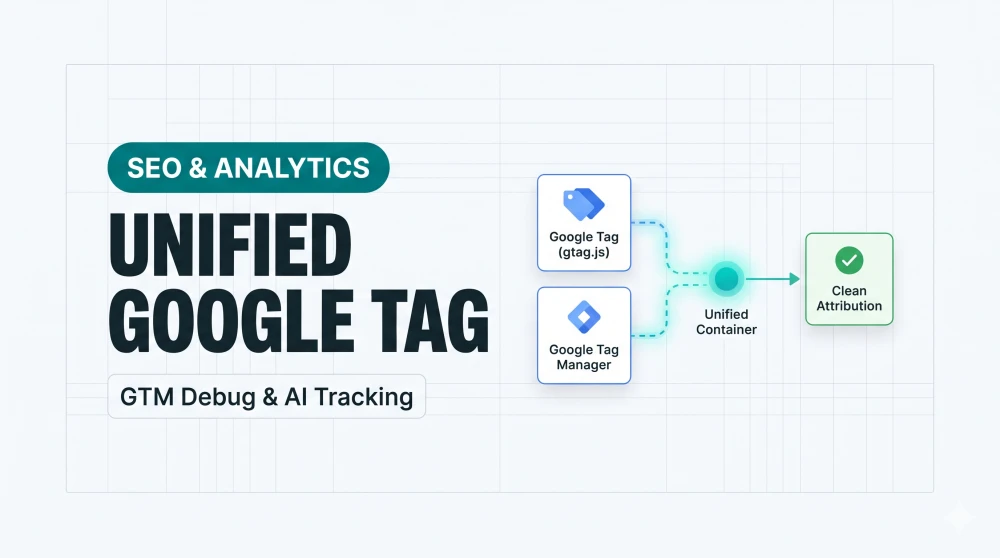
Clean analytics and accurate conversion attribution are the backbone of every high-ROI SEO and paid search campaign—yet for years, businesses have struggled with fragmented tracking setups split between standalone Google tags (gtag.js) and Google Tag Manager (GTM) containers.
On November 18, 2026, Google officially announced the unification of Google tag and Google Tag Manager, transforming every Google tag into a full Tag Manager container with built-in debugging, version control, and unified snippets—just as Google rolled out new Gemini-powered AI tools and an upcoming MCP server for AdMob.
At the same time, SEO teams trying to measure brand mentions in ChatGPT, Perplexity, and Google AI Overviews face a new measurement problem. As Search Engine Journal's November 2026 AI Visibility analysis warns, misinterpreting AI visibility scores or confusing referral logs with actual revenue can send your marketing budget in the wrong direction. Here is what changed this week and how to audit your tracking and AI search reporting before 2027.
What Changed: Every Google Tag Becomes a Tag Manager Container
According to Search Engine Land's November 18, 2026 report, Google is bringing GTM's management power directly to websites that previously only installed a basic Google tag—without breaking existing tracking behavior:
- Every Google Tag Is Now a GTM Container: Businesses running only a Google tag gain immediate access to interface-driven tagging controls, built-in debugging tools, and version management without deploying a separate GTM installation.
- Unified Deployment Snippets: All new Google tag and Google Tag Manager snippets now share a single unified installation format across Google destinations.
- No More
gtag configCommand in New Snippets: New deployment snippets drop the legacygtag('config', ...)command. Instead, Google recommends managing initialization behavior through standard Google Tag Manager Initialization triggers (or configuring an Initialization trigger to wait for the config command if legacy sequencing is required). - Unified Tag Assistant Permissions: Google Tag Manager container permissions now directly govern who can inspect and debug data inside Tag Assistant—tightening governance for agencies and in-house analytics teams.
- January 2027 Deadline for Unsupported Installations: While standard Google tags retain their existing firing behavior and triggers, Google noted that unsupported installations are scheduled for an automatic upgrade in January 2027—giving engineering and SEO teams a clear window to audit custom scripts beforehand.
How Unified Tagging Pairs With Google's New Agentic Measurement Stack
The Google Tag unification is part of a broader November 2026 push toward standardized, AI-accessible marketing infrastructure. On the exact same day, Google AdMob introduced Ask AdMob, AdMob agent skills, and an upcoming Model Context Protocol (MCP) server for mobile app publishers:
- Ask AdMob (Gemini Assistant): Analyzes app SDK integration anomalies, identifies misconfigured third-party ad networks, recommends SDK bidders using peer benchmarks, and creates custom brand-safety blocklists from natural-language prompts.
- AdMob Agent Skills (Available Now): Pre-built, tested instructions that allow AI coding agents to migrate apps to the Google Mobile Ads Next-Gen SDK, validate implementations, and add new ad formats.
- AdMob MCP Server (Early Testing): Will connect AI development environments directly to AdMob account data to create ad units and coordinate mediation settings—with human developers still responsible for reviewing and approving every change.
4 AI Visibility Data Traps That Skew SEO & GEO Reporting
Clean tagging tells you what happens on your website, but how should marketers measure what happens before the click inside AI answers? In a detailed November 2026 guide on AI visibility data, Search Engine Journal outlines four common measurement traps—and how to fix them:
- Trap 1 — Tracking Prompts Buyers Never Actually Use: A high AI visibility score (such as 72%) is meaningless if your prompt list only tests generic branded queries. Build a prompt library mapped to real Ideal Customer Profiles (ICPs), local markets, and bottom-of-funnel comparison questions pulled from sales calls and customer support tickets, and analyze each AI model individually.
- Trap 2 — Assuming Negative AI Brand Sentiment Always Needs Fixing: Automated sentiment tools often flag words like "expensive" as negative, even when that reinforces premium positioning. Always read the underlying AI answer to distinguish between an accurate premium-price description, a genuine value objection, and factually wrong product specs.
- Trap 3 — Turning Every Citation Finding Into a Channel Task: Seeing Reddit or third-party directories cited in AI answers does not automatically mean you should spam links there. Diagnose the underlying information gap first (for example, missing independent product comparisons or technical documentation) and publish authoritative answers where your buyers actually research.
- Trap 4 — Confusing Low AI Referral Traffic With Low Business Impact: Buyers routinely discover, shortlist, and evaluate B2B vendors inside AI Overviews or ChatGPT without clicking a link directly. Report monitored visibility, recorded analytics referrals, directional branded-search lift, and modeled impact as separate metrics rather than forcing false causal attribution.
Want Accurate Conversion Tracking & Higher Organic Visibility? Explore Ideate Web Solutions' SEO & Digital Engineering Services or read more growth guides on the Ideate Blog.
Your 4-Step Action Plan Before January 2027
- Audit Custom
gtag('config')Scripts Now: Check whether your website, Shopify store, or Laravel/WordPress checkout relies on custom inlinegtag configsequencing so you can migrate to GTM Initialization triggers well ahead of the January 2027 unsupported-installation upgrade. - Clean Up GTM & Tag Assistant Access: Review container user permissions to ensure only authorized developers and marketing leads have debug and publish rights.
- Separate AI Referral Metrics From Branded Search Lift: Configure clean channel groupings in your unified analytics container so direct AI referrals and organic search conversions are tracked without double-counting.
- Pair Technical SEO With Bottom-of-Funnel Comparison Content: Ensure your service pages, schema markup, and product specs answer the exact evaluation questions buyers ask AI assistants.
Frequently Asked Questions (FAQ)
1. Will Google's unification break my existing Google Analytics or Google Ads tags?
No. Google confirmed that existing Google tags will preserve their current firing behavior and event triggers. However, unsupported custom installations will be upgraded in January 2027, so teams with non-standard scripts should review their setup early.
2. Why did Google remove the gtag config command from new deployment snippets?
To unify Google tag and Google Tag Manager into a single snippet format, initialization is now handled through standard GTM Initialization triggers rather than a hardcoded gtag config command.
3. How should B2B companies measure AI search ROI if referral clicks look low?
Track four distinct signals separately: monitored prompt visibility across individual AI models, recorded AI referral sessions in analytics, directional trends in branded search and direct inquiries, and customer-reported discovery ("How did you hear about us?") on lead forms.
Fix Your Analytics, Technical SEO & AI Search Visibility With Ideate Web Solutions
Clean data and high-intent organic visibility go hand in hand. At Ideate Web Solutions, our technical SEO and web engineering team helps businesses across India and globally implement rock-solid Google Tag Manager containers, Core Web Vitals optimization, structured schema markup, and conversion-focused SEO & Web Development strategies.
- Book a Technical SEO & Tag Manager Audit: https://ideatewebsolutions.com/contact-us
- Explore Our SEO & Web Engineering Services: https://ideatewebsolutions.com/services
- Direct Engineering & SEO Contact: Email [email protected] or call/WhatsApp +91 8690433283 / +91 8866105570