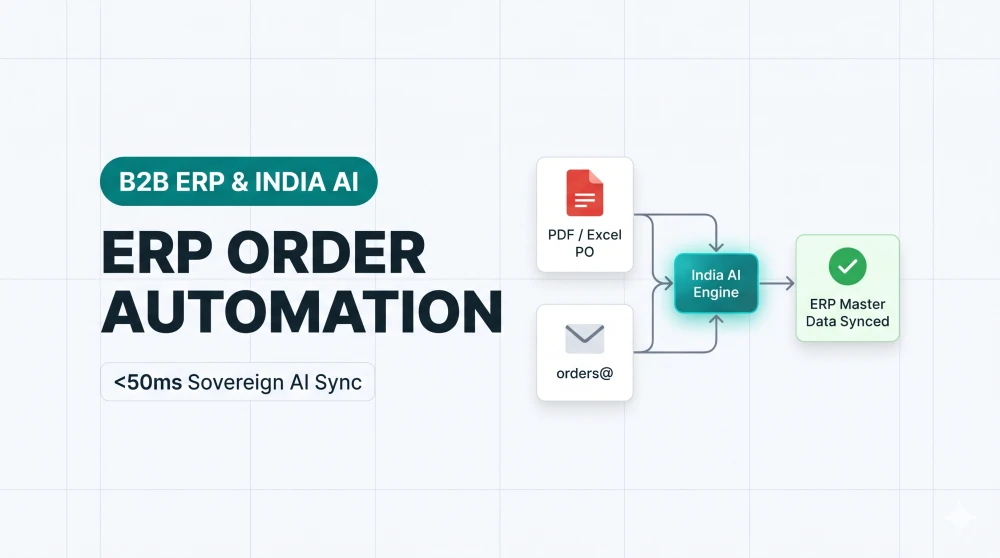
Every morning across manufacturing plants, engineering job shops, and wholesale distribution hubs—from GIDC industrial estates in Rajkot, Ahmedabad, Surat, and Vadodara to global B2B supply chains—the orders@ and service@ shared mailboxes fill up before the first operations coordinator has even logged in.
One distributor attaches a 40-line purchase order as a scanned PDF. A second buyer sends a revised Bill of Quantities (BOQ) in an Excel spreadsheet asking to move delivery up by a week. A third customer emails WhatsApp photos of a damaged pallet expecting an immediate credit note, while a fourth requests spare-part pricing and stock availability for a machine shipped years ago.
For years, software vendors tried to solve this bottleneck with shared inbox tools, ticketing systems, and basic website chatbots. Yet as the November 2026 B2B Customer Service & ERP Automation Benchmark by Cloudsquid points out, a well-written email reply closes zero actual work in a manufacturing business. The real work happens behind the message inside your ERP: matching customer part numbers against master data, checking batch inventory, verifying credit limits, updating production schedules, and generating formal sales orders or credit notes.
This week marks a major turning point for industrial and B2B software architecture. Between the November 17, 2026 launch of Sarvam Token Factory's India-hosted AI inference platform (cutting API latency below 50 milliseconds while keeping enterprise data inside Indian borders) and the rise of permission-inherited ERP agents documented in ERP News Magazine Issue #65, B2B enterprises can now connect unstructured customer emails, PDFs, and spreadsheets directly to custom ERP and CRM execution layers without sacrificing security or human control.
Message-First Helpdesks vs. Work-First ERP Execution: Why Traditional Ticketing Fails Manufacturers
Most off-the-shelf customer support platforms were designed for B2C software or retail companies where answering a question closes the ticket. In a manufacturing, chemical, CNC engineering, textile, or wholesale distribution business, an incoming message is almost always a transaction trigger.
According to the November 17, 2026 B2B Manufacturing Automation Analysis, B2B operations technology has split into two distinct architectures:
- Message-First Systems (Shared Inboxes & Standard Ticketing): Tools that sort emails into folders, assign ticket numbers, and draft polite text replies. Inside sales reps still spend 65% to 75% of their day manually copying SKU codes, quantities, and delivery dates from PDF attachments into ERP screens.
- Work-First ERP Execution Pipelines: Custom-integrated document and order pipelines that read incoming purchase orders, RFQs, bills of quantities, and supplier order confirmations in any format (email body, PDF, CSV, or Excel), validate every line item against live ERP master data, and stage a structured sales order or quote draft for a human coordinator to approve in one click.
- End-to-End Order-to-Cash & Claim Linkage: Instead of leaving warranty claims or damaged-shipment notices trapped in an email thread, work-first systems link the customer inquiry directly to the original dispatch advice, warehouse batch number, and credit-note ledger.
- Proactive Supplier Delay Resolution: As highlighted in ERP News Magazine's November 2026 cover report on Infor M3 and enterprise AI workflows, procurement officers facing a raw-material delay can now query affected production orders across the factory floor, evaluate alternative vendor lead times, and approve rescheduled work orders in minutes rather than days.
What Changed on November 17, 2026: Sarvam Token Factory Brings Sub-50ms Sovereign AI Inference to India
Until now, Indian manufacturers, exporters, and B2B enterprises hesitated to connect AI document parsers to their core ERP and accounting databases for two practical reasons: data sovereignty (sending confidential pricing, vendor invoices, and customer ledgers to foreign cloud servers) and network latency (200ms to 300ms round-trip delays to US or European data centers).
On November 17, 2026, Sarvam officially launched Token Factory, a domestic GPU inference platform physically hosted inside India's borders that eliminates both barriers for custom business software:
- 100% India Data Sovereignty & Compliance: All prompts, purchase order PDFs, ERP master-data lookups, and JSON completions are processed on GPU clusters located within Indian national jurisdiction—satisfying strict data localization policies for financial, healthcare, government, and industrial supply chains.
- Sub-50ms Real-Time Latency Across Indian Cities: By eliminating transcontinental network hops to US or European endpoints, typical API round-trip times drop from
200–300msdown tounder 50msfor applications running across Gujarat, Mumbai, Bengaluru, Delhi-NCR, and Chennai. - Eight Frontier Open-Weight Models Behind One Endpoint: Developers can route specific ERP tasks to specialized models through a single unified API, including
Sarvam 105B(a 105-billion-parameter model optimized for Indic languages and regional invoices),DeepSeek V4.1 Flash(for high-speed SKU and table extraction),GLM 5.3,Kimi K3.1 Pro(for long-context technical tenders and BOQs), and Google'sGemma 4 31B. - Drop-In OpenAI SDK Compatibility With Function Calling & JSON Mode: Because the platform adheres to the standard OpenAI REST and streaming specification—complete with strict JSON schema output and tool/function calling—engineering teams building custom Laravel, React JS, Node.js, or Python ERP platforms can switch inference to domestic infrastructure in minutes without rewriting business logic.
5 High-ROI Workflows Every B2B Manufacturer & Distributor Should Automate First
As Schneider Electric emphasized in its November 17, 2026 industrial modernization briefing, successful industrial automation is no longer about rigid, isolated scripts—it is about connecting plant-floor and supply-chain data directly to commercial decision-making. Based on our engineering work building custom business automation and ERP portals across Gujarat and global markets, here are the five highest-return workflows to implement first:
1. Multi-Format Purchase Order & RFQ Ingestion (Email, PDF & Excel to ERP)
B2B buyers rarely order through a standard retail shopping cart; they email PDF purchase orders exported from their own procurement systems or send multi-tab Excel sheets using their own internal item descriptions. A custom document-ingestion service extracts header fields (buyer GSTIN, billing/shipping plant, PO number, requested delivery date) and line items, cross-references customer-specific part aliases against your ERP item master, flags price discrepancies, and stages a validated draft order for one-click sales approval.
2. Automated Stock Availability, Lead-Time & Order Status Lookups
Up to 40% of inbound B2B emails and WhatsApp messages ask simple operational questions: "Is 500 kg of Grade-316 bar in stock?" or "Has Order #PO-8841 dispatched?" By connecting your inbox and customer portal to live warehouse inventory and transport LR tracking tables, your system can query real-time stock across multiple godowns and draft an accurate, data-backed reply in Outlook, Gmail, or WhatsApp for your sales coordinator to confirm.
3. Supplier Order Confirmations & Procurement Variance Alerts
When a raw-material vendor sends back an order confirmation PDF with a changed unit rate, partial quantity, or delayed dispatch date, manual teams often miss the discrepancy until the truck fails to arrive. Automated procurement parsers compare every incoming supplier confirmation against your original ERP Purchase Order line-by-line, immediately alerting the purchase manager to any price or delivery drift and identifying downstream production work orders at risk.
4. Warranty Claims, Damaged-Pallet Credit Notes & RMA Workflows
Handling returns and transit-damage claims through unstructured email threads leads to revenue leakage and slow customer resolution. A structured B2B claims portal captures photos, batch/lot numbers, and invoice references upfront, matches them against the original quality-control (QC) certificate and dispatch record in your ERP, and routes a pre-calculated credit note or replacement work order to finance and production.
5. Multi-Entity CFO Dashboards & Automated Days-to-Close Reporting
As WilliamsMarston NetSuite Managing Director Scott Grillo noted in ERP News Magazine Issue #65, one of the strongest predictors of ERP ROI is early CFO alignment around multi-entity financial consolidation, fixed-asset tracking, and reducing monthly days-to-close. Custom Laravel and React executive dashboards unify receivables, inventory aging, and factory job-work margins across multiple GST registrations or international subsidiaries in real time.
Planning an ERP, CRM, or B2B Portal Upgrade? Explore Ideate Web Solutions' Custom Software & ERP Development Services or browse our Engineering Portfolio to see how we build tailored web, mobile, and automation systems that match your exact factory and distribution workflows.
Architectural Blueprint: How to Deploy Permission-Safe AI Inside Custom Laravel & React ERP Systems
The biggest mistake companies make when adding AI to business software is granting an AI agent blanket administrator access to the database. Both Infor's November 2026 enterprise architecture and Unanet's newly launched deterministic Champ Agents enforce a strict architectural rule that every custom software system should follow: inherited user permissions and deterministic human approval.
When our engineering team at Ideate Web Solutions architects custom B2B software using Laravel, React JS, Angular, and mobile companion apps, we enforce a five-layer security and accuracy pipeline:
- Role-Inherited Scoped Queries (Zero Privilege Escalation): The AI worker never queries the database with a global root key. Every lookup and proposed action inherits the exact Role-Based Access Control (RBAC) token of the signed-in employee or B2B dealer—meaning a regional sales executive can only query and stage orders for their assigned territory and price book.
- Deterministic JSON Schema Validation against ERP Master Data: Model outputs from sovereign endpoints like
Sarvam Token Factoryare constrained to strict JSON schemas and validated against deterministic PHP/Laravel business rules—checking exact SKU codes, HSN tax rates, minimum order quantities (MOQs), and buyer credit limits before a record is ever created. - Human-in-the-Loop Staging Tables: Parsed purchase orders, quote drafts, and production schedule adjustments are written to an
erp_staged_actionsreview queue first. Inside sales or procurement staff see a side-by-side view of the original PDF/Excel file and the matched ERP fields, approving or editing the transaction in seconds. - Regional Indic Language & Multi-Channel Support: By pairing
Sarvam 105Bwith WhatsApp Business APIs and dealer mobile apps built in React Native, distributors and plant supervisors can submit voice notes or regional-language inquiries in Gujarati, Hindi, or English that map cleanly into structured English ERP tickets. - Immutable Audit Logs & Rollback Versioning: Every automated extraction, master-data match, and human approval timestamp is logged with full user attribution so finance teams and ISO/statutory auditors have a 100% traceable ledger.
Frequently Asked Questions (FAQ)
1. What is the difference between a shared inbox tool and B2B ERP order automation?
A shared inbox or helpdesk tool only organizes incoming emails and helps staff type text replies. B2B ERP order automation reads the actual PDF, Excel, or email purchase order attached to the message, matches every item against your ERP master data (SKUs, contract pricing, inventory, and tax rules), and stages a ready-to-approve sales order or quote directly inside your ERP system.
2. How does Sarvam Token Factory benefit Indian manufacturers and B2B enterprises?
Launched on November 17, 2026, Sarvam Token Factory hosts eight frontier open-weight AI models (including Sarvam 105B, DeepSeek V4.1 Flash, GLM 5.3, Kimi K3.1 Pro, and Gemma 4 31B) on GPU servers physically located inside India. This keeps confidential corporate data within Indian jurisdiction for compliance while cutting API response latency from 200–300ms down to under 50ms.
3. Can AI agents modify ERP production schedules or pricing without human approval?
In a properly engineered enterprise system, no. Following 2026 best practices for permission-inherited ERP automation, the AI service inherits the signed-in user's exact role permissions and writes proposed orders or schedule changes into a staging queue. No production order, price override, or accounting entry is committed until an authorized human reviewer approves it.
4. Can custom order automation integrate with Tally, SAP, Oracle NetSuite, or a custom Laravel ERP?
Yes. A modular middleware layer built in Laravel and Node.js can ingest PDFs, Excel sheets, emails, and WhatsApp messages, validate the extracted data against your business rules, and sync approved orders into custom Laravel/React ERPs, Tally Prime, SAP Business One, SAP S/4HANA, Microsoft Dynamics 365, or Oracle NetSuite via REST APIs and webhooks.
Automate Your B2B Order Entry & ERP Workflows With Ideate Web Solutions
If your sales engineers, procurement officers, and accounting teams are still losing hours every day manually retyping PDF purchase orders, Excel BOQs, and vendor confirmations into your software, it is time to upgrade from message management to true ERP execution.
At Ideate Web Solutions, our engineering team in Rajkot, Gujarat architects secure, high-performance Custom ERP & CRM Software, B2B Dealer Portals, Web Applications, and Mobile Apps using Laravel, React JS, Angular, React Native, and India-hosted sovereign AI pipelines tailored for manufacturers, exporters, and growing enterprises worldwide.
- Request a Custom ERP & Automation Architecture Consultation: https://ideatewebsolutions.com/contact-us
- Explore Our B2B Software & Web Engineering Services: https://ideatewebsolutions.com/services
- Read Our Gujarat Business Automation Guide: Website, Mobile App & Automation Guide for Ahmedabad, Rajkot, Surat & GIDC Industries
- Direct Engineering Contact: Email [email protected] or call/WhatsApp +91 8690433283 / +91 8866105570