
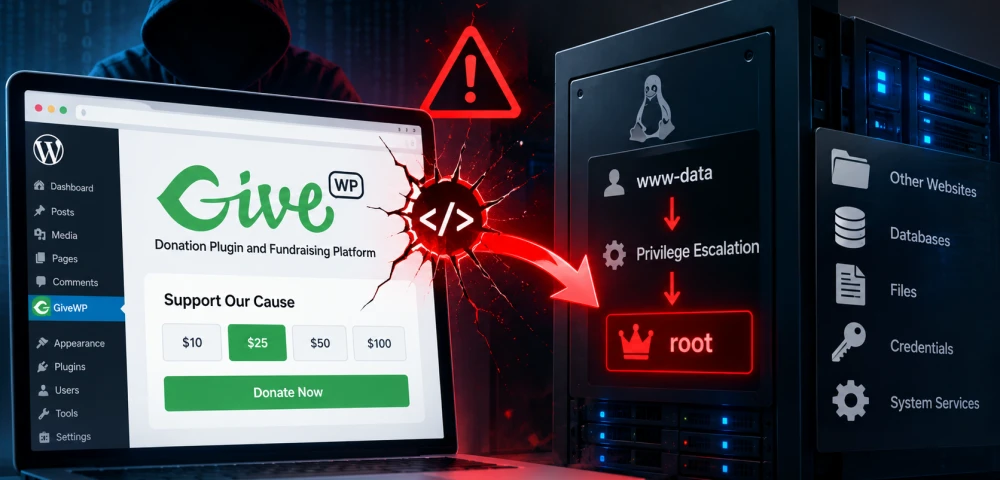
GiveWP Security Vulnerability: Can It Lead to Full Server Compromise?
GiveWP – Donation Plugin and Fundraising Platform is a popular WordPress plugin used for donations and fundraising. Like other large WordPress plugins, GiveWP has had several security vulnerabilities, including critical vulnerabilities that could allow unauthenticated attackers to execute code remotely.
One notable example is CVE-2024-5932, which affected GiveWP versions up to 3.14.1. The vulnerability involved PHP Object Injection and could allow an unauthenticated attacker to achieve remote code execution and arbitrary file deletion.
Can GiveWP Give an Attacker Root Access?
Not directly.
A vulnerable GiveWP installation can potentially provide an attacker with code execution through the WordPress website. The initial privileges normally depend on the Linux user running PHP.
A simplified attack chain looks like:
Internet
   ↓
Vulnerable GiveWP
   ↓
Remote Code Execution
   ↓
PHP/Web Server User
   ↓
Privilege Escalation
   ↓
root
The important point is that GiveWP RCE and Linux root access are different things.
If PHP runs as www-data, the attacker initially has www-data privileges. To become root, they need another path, such as a server misconfiguration, exposed credentials, a vulnerable system service, weak permissions, or a privilege-escalation vulnerability.
What If GiveWP Is Installed on Only One Website?
Even if GiveWP is installed on only one website, that website can potentially become the entry point to the server.
For example:
Ubuntu Server
└── Website A
    └── WordPress
        └── Vulnerable GiveWP
If the attacker later escalates from the web-server user to root, the compromise is no longer limited to WordPress. Root access can provide control over the entire server, including other websites, databases, files, credentials, and system services.
Therefore, the key security question is not simply “Where is GiveWP installed?” but:
What privileges does the compromised WordPress/PHP process have, and can those privileges be escalated to root?
How to Reduce the Risk
- Keep GiveWP and WordPress updated.
- Remove outdated or unused plugins.
- Run websites under separate Linux users where possible.
- Do not give web-server users unrestricted
sudoaccess. - Keep PHP and Ubuntu packages patched.
- Review file and directory permissions.
- Monitor unexpected PHP files and system changes.
- Investigate the server if an old vulnerable GiveWP version was previously installed.
In short: A vulnerable GiveWP plugin can be an initial entry point for remote code execution, but it does not inherently grant Linux root access. Full server compromise requires an additional path from the web-server account to root.